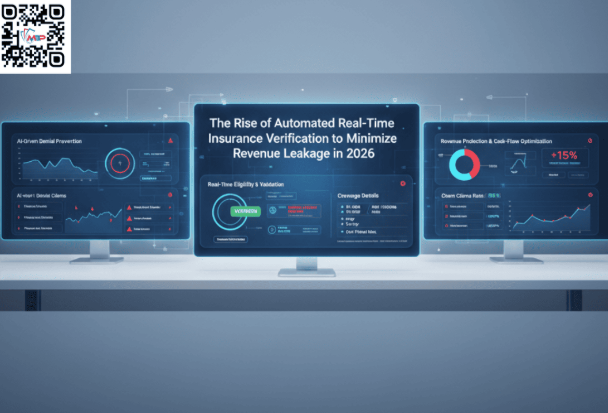

The healthcare financial landscape in 2026 has reached a definitive turning point. As payers deploy increasingly sophisticated AI-driven “denial engines” to scrutinize claims, healthcare providers are facing a stark reality: the traditional, manual methods of checking coverage are no longer just inefficient—they are a primary source of revenue leakage.
Recent industry reports from leading healthcare intelligence platforms indicate that nearly $262 billion in claims are denied annually across the U.S., with a staggering 15-30% of those denials stemming directly from eligibility and registration errors. In an era of high-deductible plans and volatile policy statuses, the “bill now, verify later” approach has become a financial liability.
The solution that is defining 2026 is Automated Insurance Verification 2026. By shifting from reactive manual lookups to autonomous, instant validation, providers are finally plugging the holes in their revenue cycles before the patient even walks through the door.
Why Manual Verification is the #1 Driver of Revenue Leakage
In 2026, the complexity of insurance plans has surpassed human capacity for manual tracking. Policyholders frequently switch between plans, Medicaid redeterminations are in constant flux, and the “phygital” (physical + digital) care model means patients are accessing services across multiple touchpoints.
The Cost of the “Verification Gap”
When a front-desk staff member relies on outdated portals or—worse—fax machines to verify coverage, the margin for error is massive. A single transposed digit in a subscriber ID or a failure to notice a recently met deductible can lead to a denial that costs between $25 and $118 per claim to rework. For a mid-sized facility, this “administrative friction” can erode net margins by 3-5% annually.
4 Strategic Trends in Real-Time Eligibility for 2026
To combat these losses, high-performing RCM teams are adopting Real-Time Eligibility Automation strategies that go beyond a simple “active/inactive” check.
- Instant API-Driven Adjudication
Modern systems no longer wait for a human to log into a payer portal. Instead, they use direct API (Application Programming Interface) connectivity to perform AI Insurance Checks in under five seconds. These systems pull granular data including:
- Remaining deductible balances.
- Specific co-insurance percentages for the scheduled procedure.
- Telehealth vs. in-person coverage variations.
- Service-specific limitations (e.g., “3 visits per year” caps).
- Zero-Day “Self-Healing” Registration
In 2026, Insurance Verification Trends are moving toward “self-healing” workflows. If the AI detects an eligibility mismatch during the pre-registration phase, it autonomously triggers a text message to the patient, asking them to upload a photo of their new insurance card. The system then parses the image, updates the EHR, and re-verifies the claim—all without a staff member ever lifting a finger.
- Predictive Denial Prevention
Verification is no longer just about checking “is the insurance good?” It’s about Claim Denial Prevention Verification. Advanced AI models now analyze a payer’s current “denial behavior” in real-time. If a specific payer is suddenly denying a certain CPT code due to new prior authorization rules, the verification tool flags the visit before care is rendered, ensuring the authorization is secured upfront.
- Dynamic Financial Transparency
Patients in 2026 are highly price-sensitive. Automated verification allows providers to offer accurate “Good Faith Estimates” at the point of service. When a patient knows exactly what they owe (and why) before the appointment, point-of-service collections increase by an average of 14% to 20%.
The ROI of Automation: A 2026 Comparison
| Metric | Manual Verification (Legacy) | Automated Real-Time (2026) |
| Verification Speed | 10-15 minutes per patient | < 5 seconds |
| Eligibility Denial Rate | 8% – 12% | < 1.5% |
| A/R Days (Average) | 45 – 55 Days | 22 – 28 Days |
| Point-of-Service Collections | ~60% Accuracy | ~98% Accuracy |
| Staff Focus | Repetitive portal logins | High-value patient advocacy |
How “My Billing Provider” Seals the Leaks in Your Revenue Cycle
At My Billing Provider, we recognize that insurance verification is the “first domino” in the revenue cycle. If it falls correctly, the rest of the process—coding, billing, and reconciliation—follows seamlessly. If it fails, the entire system collapses into a cycle of denials and rework.
Our AI-Powered Verification & Coding Ecosystem
While many vendors offer standalone tools, My Billing Provider provides a unified, cutting-edge solution designed for the 2026 regulatory environment.
- Seamless Integration: Our platform fits effortlessly into your existing procedures, connecting your EHR directly to our AI-powered IPDRG coding and verification engines.
- Hyper-Precision: Our powerful algorithms don’t just verify coverage; they evaluate medical records to ensure that the billed services align perfectly with the patient’s specific plan benefits.
- Scalable for Any Volume: Whether you are a tiny clinic or a large hospital network, our flexible platform handles your complexity, minimizing disturbance and increasing efficiency.
By utilizing Healthcare Payment Reconciliation and automated verification from My Billing Provider, you aren’t just buying software—you are acquiring a strategic asset that safeguards your margins.
Conclusion: Turning Eligibility into a Strategic Advantage
In 2026, the most successful healthcare organizations are those that treat eligibility verification not as a “check-in” task, but as a strategic revenue control point. By adopting Automated Insurance Verification 2026, you eliminate the guesswork, reduce administrative burnout, and—most importantly—ensure you are paid fairly and promptly for the care you provide.
The technology is no longer a luxury; it is the foundation of a healthy medical practice.
Is your front-end process leaking revenue through outdated manual checks?
Contact My Billing Provider today to learn more about our AI-powered solutions. Our committed team of professionals is here to answer your concerns, provide individual advice, and help you on your path to better financial performance.